Research · Prepared for Krisbo Liu, RedirHub
The Number That Moves
Why a live, exact number earns more trust than a rounded one — and why RedirHub is in a rare position to prove it on its own homepage.
01The question
RedirHub’s homepage makes strong claims: 100M+ redirects a day, 1M+ domains, 900K+ SSL certificates, 90ms latency, 99.99% uptime. They are real numbers. But on the page, they look the same as every other SaaS badge on the internet. Any company can type “100M+”.
So the question is simple: if those numbers were exact and updated live, would a visitor believe them more? The research and the market both say yes. Here is why.
02What the research says
Exact numbers read as measured. Round numbers read as guesses.
People know that estimates come out round. So when a claim uses a sharp number, readers assume someone measured it, and they rate it as more factual and more believable.
Schindler & Yalch, “It Seems Factual, But Is It? Effects of Using Sharp versus Round Numbers in Advertising Claims,” Advances in Consumer Research, 2006.
Precision signals competence — but skeptics need more.
In four experiments, precise numbers made a company look more competent. The catch: highly skeptical readers were not moved by precision alone.
RedirHub sells to developers, agencies and IT teams. Skeptical is their job. For this audience, an exact number is not enough. They need to see that it is real. A number that changes while they watch is that proof.
Xie & Kronrod, “Is the Devil in the Details? The Signaling Effect of Numerical Precision,” Journal of Advertising 41(4), 2012.
Make it easy to verify.
The first of Stanford’s ten web credibility guidelines is “Make it easy to verify the accuracy of the information on your site.” A live counter with a link to its source (a status page, a public report) turns a claim into something a visitor can check.
B.J. Fogg, Stanford Guidelines for Web Credibility, Stanford Persuasive Technology Lab, 2002.
A signal only counts if it is hard to fake.
Signaling theory says a claim earns trust in proportion to what it costs to make. Writing “100M+” costs nothing. Running a public, live feed of real traffic costs real engineering — and only a company with that traffic can do it. That cost is exactly why visitors believe it.
Spence, “Job Market Signaling,” Quarterly Journal of Economics 87(3), 1973.
03Who already does this
Four companies that put a real, current number in front of visitors. Each one uses it for a different job.
Wise — the number is the promise
wise.com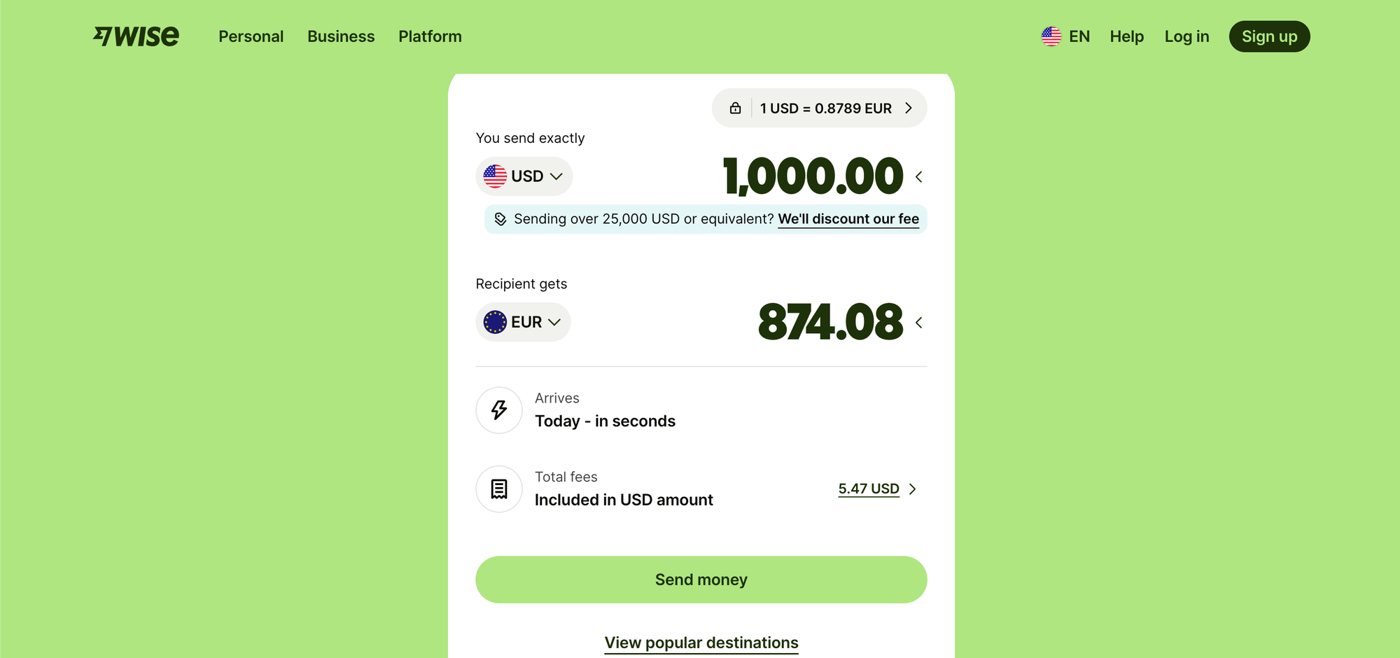
The first thing on Wise’s calculator is the live rate: 1 USD = 0.8789 EUR, locked for you. Below it, the exact amount the other person gets (874.08 EUR) and the exact fee (5.47 USD). Wise calls it “the real, mid-market rate with no sneaky mark-up,” and anyone can check it against Google in a second tab.
What it proves: “We have nothing to hide.” The live number carries the whole brand claim.
Plausible — the product runs in public
plausible.io
Plausible shows its own analytics dashboard, open to anyone: 150 current visitors with a green dot, 952k unique visitors and 6M pageviews over the last 91 days, with the chart to back it up. The weekday peaks and weekend dips are right there. Nobody would fake a chart that messy.
What it proves: “It works, and it works on us.” The demo is the product and the proof at once.
Ghost — exact, and dated
ghost.org
Ghost does not say “thousands of creators.” It says “Last week, 29,074 brand new publications got started with Ghost.” Then: “Today, it’s your turn.” An exact number, tied to a specific week, turned straight into the call to action.
What it proves: “People are joining right now.” Momentum, not a lifetime total.
Papermark — money moving, with names
papermark.com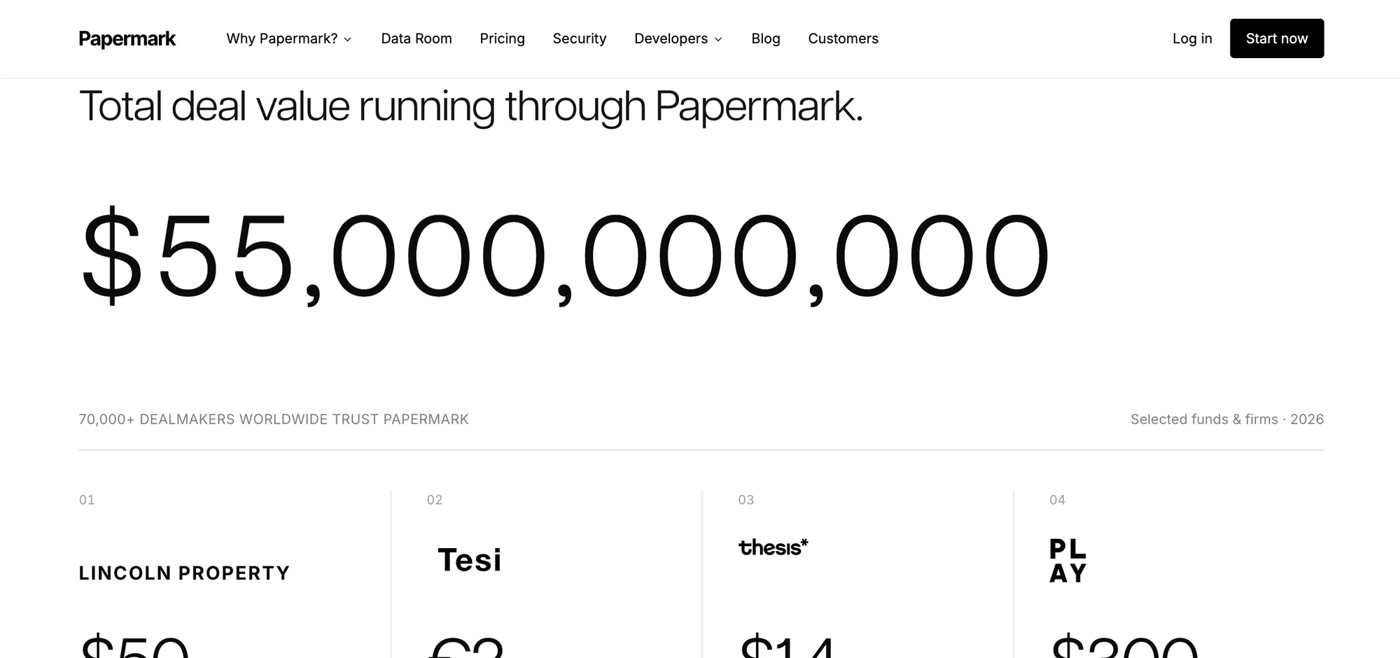
Papermark writes the number out in full — $55,000,000,000 of deal value running through the platform — then names who it comes from: Lincoln Property ($50 billion), Tesi (€2 billion), thesis* ($1.4 billion), PLAY ($300 million). The total says scale. The names say the scale is made of real customers.
What it proves: “Serious people trust us with serious money.”
Screenshots taken 24 September 2026.
04What RedirHub already has
This is the part that surprised me. RedirHub already publishes live data. The “View real-time speed report” link goes to findredirect.com/uptime. It checks RedirHub and its competitors every five minutes from 11 regions.
When I checked it on 24 September 2026, it showed:
RedirHub’s live response time was 68ms. The homepage says 90ms. Same day, Bitly was at 379ms, Urllo at 433ms and Rebrandly at 569ms.
The static number undersells the company. The best proof RedirHub has sits one click away, on another domain, where most visitors will never go. Bringing it onto the homepage — live — fixes both problems at once.
| Stat | Today | Live version (example) | Source it can read from |
|---|---|---|---|
| Latency | 90ms | 68ms, updated every few seconds, with a sparkline | The same monitor behind the speed report |
| Redirects / 24h | 100M+ | 104,318,772 and counting | Edge request counters, rolling 24h |
| Domains | 1M+ | 1,046,219 domains served today | Distinct hostnames served per day |
| SSL | 900K+ | 912,480 issued, last 60 days | Certificate issuance log |
| PoPs | 130 | 130 online, lit on a map | PoP health checks |
| Uptime | 99.99% | 99.998%, last 90 days, with a day-by-day bar | redirhub.statuspage.io |
05The honest risks
- Numbers can go down. Use rolling windows (last 24 hours, last 60 days) so the number stays steady and never looks like a drop-off. A counter should count up; the window does the rest.
- It must be real. A fake ticker is worse than none. Developers will open DevTools. If the number is a
setIntervalwith no source, trust breaks and it does not come back. Every live stat should link to where it comes from. - Speed of the page. One small cached JSON endpoint (refresh every 10–30 seconds) is enough. The page animates between real readings, so it feels continuous without hitting the backend constantly.
- Accessibility. Motion respects “reduce motion.” Screen readers get the number once, not every tick.
06Recommendation
- Swap the rounded stats for exact, live ones in the “Why RedirHub Stands Out” section. Same layout, same claims — now proven.
- Lead with latency. It is the most impressive number, it is already measured, and the live figure beats the one on the page today.
- Put a “live” marker and a source link on each stat. The green dot says “this is real.” The link lets a skeptic check.
- Serve one cached stats endpoint. Small engineering cost, large trust return.
See the live section →
—Sources
- Schindler, R. M. & Yalch, R. F. (2006). It Seems Factual, But Is It? Effects of Using Sharp versus Round Numbers in Advertising Claims. Advances in Consumer Research 33.
- Xie, G.-X. & Kronrod, A. (2012). Is the Devil in the Details? The Signaling Effect of Numerical Precision in Environmental Advertising Claims. Journal of Advertising 41(4), 103–117.
- Fogg, B. J. (2002). Stanford Guidelines for Web Credibility. Stanford Persuasive Technology Lab.
- Spence, M. (1973). Job Market Signaling. Quarterly Journal of Economics 87(3), 355–374.
- Live examples: wise.com, plausible.io, ghost.org, papermark.com, findredirect.com/uptime — all captured 24 September 2026.
← All research · Live RedirHub section · Trey Vititoe